
Condition
SI Joint Pain
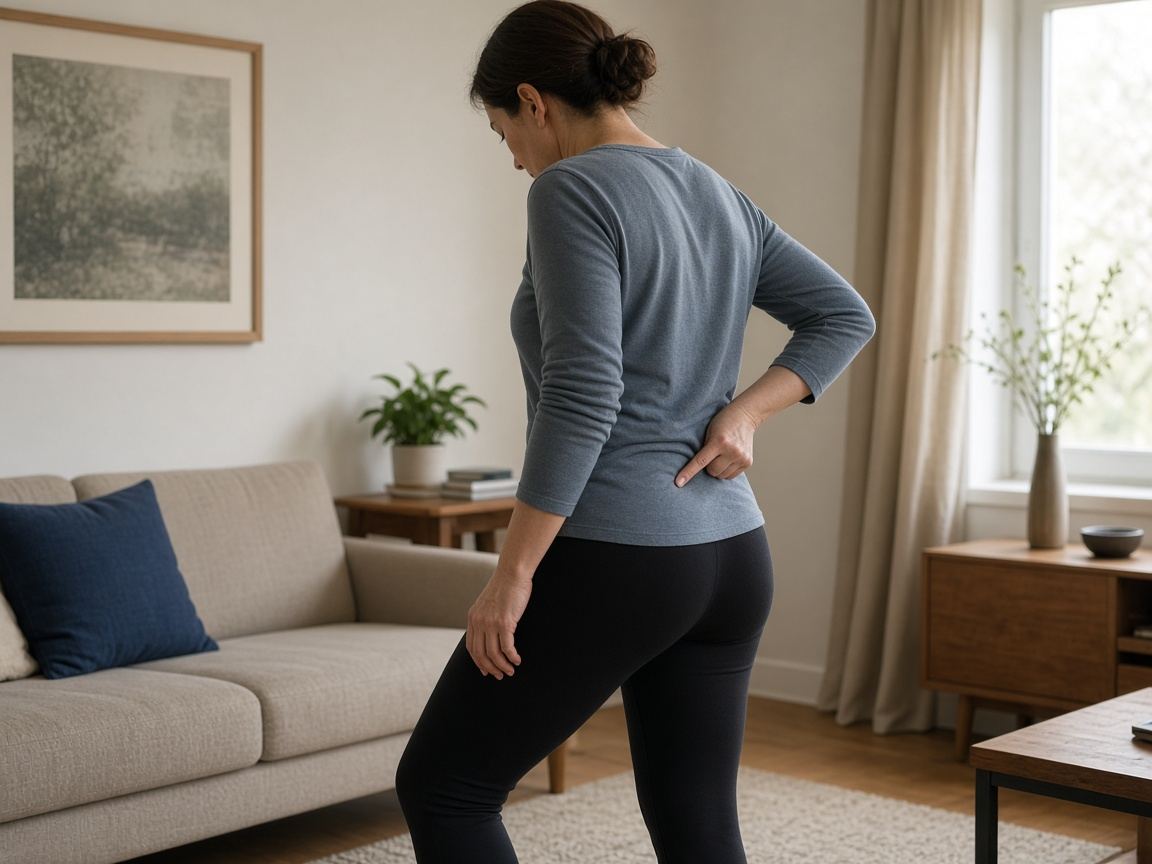
SI joint pain is the sentence a lot of people hear after someone said “your SI is out.” The sacroiliac joints transfer load between spine and legs. Sitting on a wallet, stepping out of a truck, and third-trimester sleep all irritate them.
We treat the joints, the gluteal sling, and the lumbar segments that cheat when the SI is angry. Taping helps some prenatal patients through a week. The jeans-pocket complaint is often mixed with hip or lumbar pain, so we exam all three.
True inflammatory sacroiliitis (ankylosing patterns, morning stiffness with systemic signs) is rheumatology. We will not adjust through that undiagnosed.
The sacroiliac joints are where the sacrum wedges between the two halves of the pelvis, and their job is transferring load between the spine and the legs. They are built for stability rather than motion: rough, interlocking surfaces and an extremely strong ligamentous network. Force closure — the compression generated by the gluteals, the deep abdominals, the pelvic floor, and the latissimus dorsi working through the thoracolumbar fascia — is what keeps them stable under load. When that muscular system is not doing its share, the ligaments and joint surfaces take the strain instead.
That is why the histories are so consistent. Pregnancy, where relaxin increases ligament laxity while the load increases. A fall onto one buttock. Stepping down awkwardly off a truck or a curb. A long period of sitting asymmetrically. Running on a cambered road. And the group we see most in Delaware — people whose gluteal function has quietly declined through months of desk work, who then do something ordinary on the weekend and cannot straighten up.
Diagnosis rests on clustering, not on any single test, because no individual SI test is reliable on its own. We use a group of provocation tests — distraction, compression, thigh thrust, sacral thrust, and Gaenslen's — and treat three or more positives as meaningful. Alongside that we test the lumbar spine and the hip, because both refer into the same area and both are misdiagnosed as SI regularly. Pointing to one spot just inside the pelvic dimple is a useful clue but not a diagnosis.
Treatment has two halves and skipping the second is why these recur. The hands-on half is adjusting or mobilising the joint, releasing the gluteals, piriformis, and thoracolumbar fascia, and settling the lumbar segments that have been compensating. The active half is restoring force closure: gluteal strengthening, deep abdominal control, and single-leg stability work. Most cases improve substantially inside four to six weeks. Pregnancy-related cases are managed differently, with side-lying positioning, low-force technique from Webster-trained doctors, and often a support belt.
Where we stop: inflammatory sacroiliitis. Morning stiffness lasting more than an hour, pain that improves with activity rather than rest, night pain in the second half of the night, alternating buttock pain, or a personal or family history of psoriasis, inflammatory bowel disease, or uveitis points at axial spondyloarthritis. That is a rheumatology diagnosis with a specific medical treatment pathway, and delay costs people years.
Related conditions
Services that often help
Doctors to start with
This complaint at a specific clinic
This page is the statewide guide. Each clinic site has its own address, doctors, and hours for si joint pain — that is the page to open if you already know which office you will attend.
FAQ
How do I know it is my SI joint?
A one-finger point on the posterior superior iliac spine is a clue, not a diagnosis. We exam lumbar discs and hip so we do not treat sciatica as SI or SI as hip arthritis.
Is SI pain common in pregnancy?
Very. Changing ligaments and load pick on the pelvis. Webster-trained doctors in Newark, Dover, and Wilmington modify force and positioning.
Can the SI joint really go out of place?
Not in the way the phrase suggests. The sacroiliac joints are bound by some of the strongest ligaments in the body and move only a couple of millimetres. What genuinely happens is that the joint becomes irritated and the surrounding muscles guard, which produces the locked, stuck sensation people describe. The distinction matters because it changes the goal — we are restoring normal movement and calming an irritated joint, not putting a bone back.
Why does it hurt to roll over in bed?
Rolling over asks the two halves of the pelvis to move relative to each other while the trunk muscles are relaxed and offering no support. That is close to a provocation test for an irritated SI joint, which is why it is one of the most consistently reported symptoms. Getting out of a car and going up stairs load it in a similar way.
How is SI pain different from sciatica?
SI referral typically stops at the buttock or the back of the thigh and does not usually reach below the knee, and it is not accompanied by numbness, pins and needles, or weakness. Nerve-root pain from a lumbar disc travels in a defined line, frequently past the knee into the calf or foot, and often brings sensory or strength changes with it. When both patterns are present together, and they can be, the exam sorts out which is driving the complaint.
Does a belt or brace help?
For pregnancy-related pelvic girdle pain and for genuinely hypermobile joints, a sacroiliac belt worn low across the pelvis often helps a great deal, and it is cheap enough to be worth trying. It is a support for symptomatic periods rather than a long-term solution — worn constantly, it allows the muscles that should stabilise the pelvis to do progressively less.