
Condition
Shoulder Pain
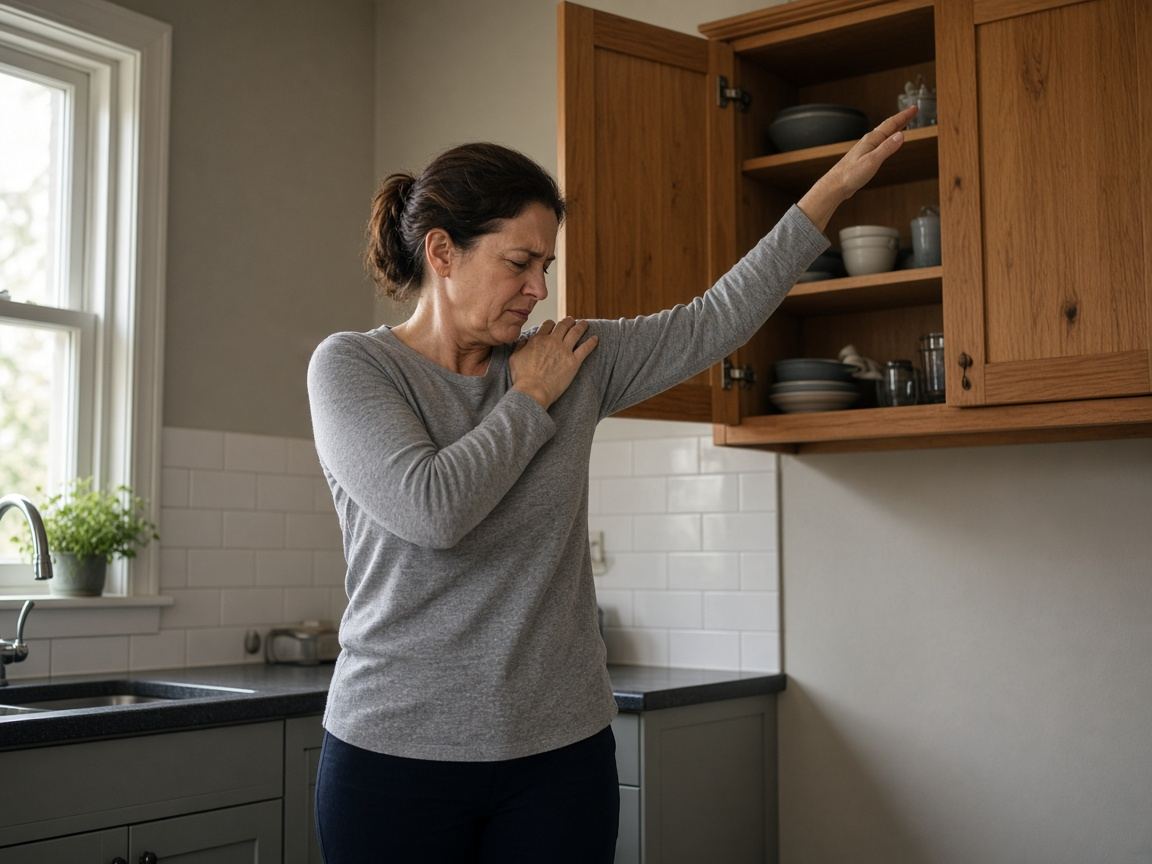
Shoulder pain in Wilmington and Newark often shows up as a rotator cuff, impingement, not being able to sleep on that side, or pain reaching into the back seat. Sometimes the cuff is the story. Sometimes C5–C6 is referring and the MRI of the shoulder is a distraction.
Dr. Hierlmaier is often the shoulder name in this group. Dr. Richardson lists extremities among his focuses. Taping gets people through a work week; shockwave in three clinics is for the tendon that has been angry for months.
If the arm also goes numb, that is a nerve pattern — we will not treat it like bursitis. Athletes get a return-to-play plan. Red-flag fever, unexplained weight loss, or a true drop-arm after trauma needs medical imaging, not a first-visit hero adjustment.
The shoulder trades stability for range, and everything that goes wrong with it follows from that bargain. A shallow socket and a large humeral head give the arm more motion than any other joint in the body, and the price is that stability depends almost entirely on soft tissue: the rotator cuff, the labrum, and the capsule. The four cuff muscles have a job beyond moving the arm — they hold the humeral head centred in the socket while the much larger deltoid lifts. When they fatigue or are torn, the head rides upward and the tissues in the subacromial space get compressed with every overhead reach.
The shoulder blade is the other half of the mechanism and it is where a lot of stubborn cases actually live. Roughly a third of total arm elevation comes from the shoulder blade rotating on the rib cage, so if the blade does not rotate properly the shoulder joint has to make up the difference and the space available for the cuff tendons closes down earlier. That is why a stiff mid-back and poorly controlled scapular muscles show up so often in shoulders that have not responded to treatment aimed only at the joint.
Our exam works through it systematically: cervical screening first to rule out referral, then active and passive range in every direction, then strength testing of each cuff muscle individually, then impingement and labral tests, then scapular mechanics watched from behind during elevation. The passive range finding is the one that redirects everything — a shoulder that is stiff even when someone else moves it is a capsular problem, not a cuff problem, and it is treated differently.
Treatment is built around what the exam found. Cuff-related cases get progressive loading of the cuff and scapular muscles, which is the intervention with the strongest evidence in this condition, plus soft-tissue work and joint mobilisation to restore what has been lost and thoracic work so the shoulder blade can move. Frozen shoulder gets stage-appropriate care and honest expectations. AC joint problems get local treatment and load management. Neck-driven cases get treated at the neck.
Shockwave at Newark, Wilmington, and Smyrna has a role in calcific tendinopathy and stubborn cuff tendinopathy that has not responded to a proper loading programme. Taping helps people get through a work week while the loading programme does the actual work. Neither is a substitute for the exercise half.
Referral triggers we take seriously: an inability to lift the arm at all after a fall or dislocation, obvious deformity, a positive drop-arm test, night pain with fever or weight loss, and any shoulder pain arriving with chest tightness, breathlessness, or sweating — left shoulder pain can be cardiac and that goes to emergency care rather than to us.
Related conditions
Services that often help
Doctors to start with
Verified outcomes at our clinics
Documented shoulder pain cases on ChiropracticResults.com — not a guarantee of individual results.
Wilmington
7 verified shoulder pain outcomes
Wilmington clinic →Middletown
4 verified shoulder pain outcomes
Middletown clinic →Smyrna
4 verified shoulder pain outcomes
Smyrna clinic →This complaint at a specific clinic
This page is the statewide guide. Each clinic site has its own address, doctors, and hours for shoulder pain — that is the page to open if you already know which office you will attend.
FAQ
Do chiropractors treat shoulders or only spines?
Both. Extremity adjusting, taping, massage, and shockwave are used when the glenohumeral joint or rotator cuff is the problem.
Is this frozen shoulder?
Frozen shoulder is a stiffness pattern we exam for. True adhesive capsulitis is a longer course. We do not diagnose it from a blog — we measure motion.
When is shockwave used?
For stubborn tendon complaints after exam, in Newark, Wilmington, and Smyrna. It is not offered at every Delaware office.
What does the pattern of pain tell you?
A great deal, and it usually points at the diagnosis before any imaging. Pain on the outside of the upper arm that is worse reaching overhead or out to the side suggests rotator cuff. Pain at the front, deep in the joint, with stiffness in every direction including when someone else moves the arm for you, suggests a frozen shoulder. Pain over the top of the shoulder at the AC joint hurts on reaching across the body. And pain that travels below the elbow, especially with pins and needles, is usually the neck rather than the shoulder at all.
Why can I not sleep on that side?
Lying on the affected shoulder compresses the subacromial space directly, and lying on the other side lets the painful arm drop forward across the body into the same closed-down position unless it is supported. It is one of the most reliable features of a genuine cuff or bursal problem. A pillow hugged in front to keep the arm supported solves it for most people and is worth trying tonight.
Do rotator cuff tears always need surgery?
No, and this is one of the biggest gaps between what scans show and what people need. Degenerative partial-thickness tears are extremely common in people over fifty who have no symptoms at all, so a tear on a scan does not by itself explain the pain. Structured rehabilitation produces outcomes comparable to surgery for many degenerative tears. Acute traumatic full-thickness tears in younger, active patients are a different situation and those get referred promptly.
How long does a frozen shoulder last?
Longer than anyone wants to hear: typically one to three years through freezing, frozen, and thawing phases, though good management shortens the middle of that considerably. It is more common in people with diabetes or thyroid disease, which is why we ask. Treatment is stage-dependent — aggressive stretching during the painful freezing phase makes it worse, while the same work in the thawing phase is exactly right.